
Providers and keys
Cloud providers, local model endpoints, and how API keys are stored.
Terax sends cloud requests from your machine to the selected provider using its Rust HTTP client (ai_http_request, ai_http_stream).
Cloud providers
Built on the Vercel AI SDK v6 (@ai-sdk/*):
- OpenAI
- Anthropic
- Google (Gemini)
- Groq
- xAI (Grok)
- Cerebras
- OpenRouter
- DeepSeek
- Mistral
- OpenAI-compatible - any custom base URL that speaks the OpenAI Chat Completions / Responses shape
Each provider has its own card in Settings -> Models. Paste a key, pick a model, done.
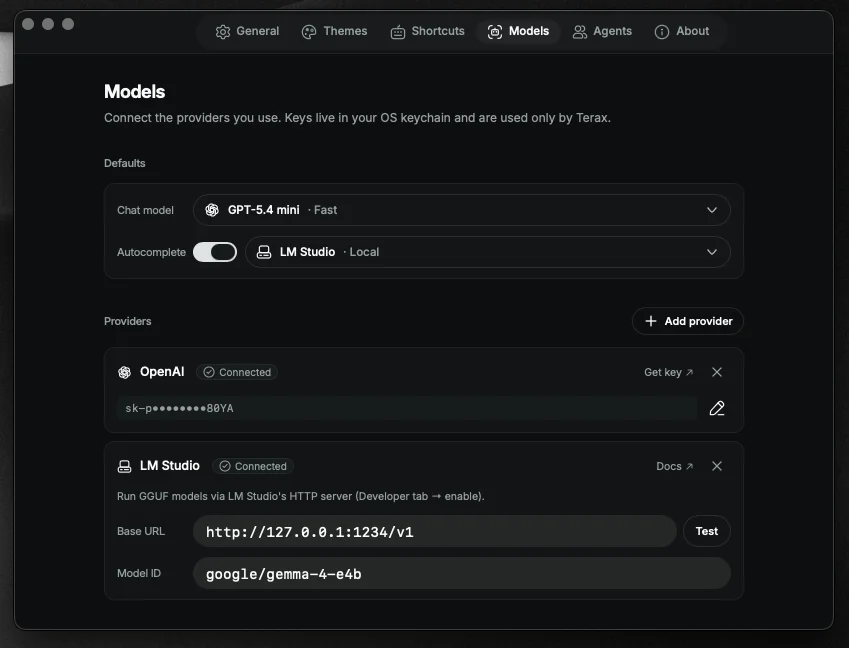
Local and offline
Key-optional, model id supplied at runtime:
- LM Studio - default base
http://127.0.0.1:1234/v1 - MLX - default base
http://127.0.0.1:8080/v1, optimized for Apple Silicon - Ollama - default base
http://127.0.0.1:11434
Override the base URL per provider in Settings. A reachability indicator (lm_ping) verifies the endpoint when you save.
Model picker
The composer's model picker shows your active provider's model registry, plus favorites and recents you can pin.
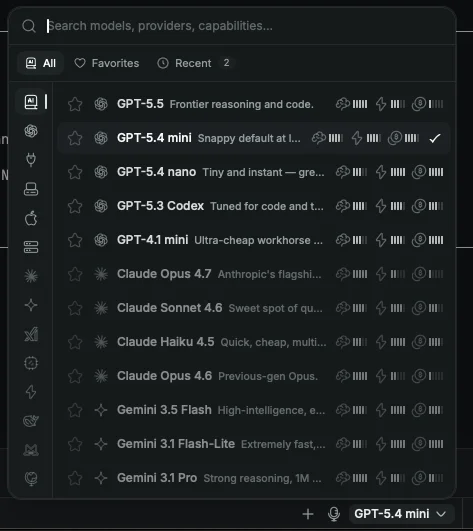
The default model id (DEFAULT_MODEL_ID) and the default autocomplete model (DEFAULT_AUTOCOMPLETE_MODEL) are settable in Settings -> Models.
Key storage
Keys go to the OS keychain via the keyring Rust crate:
- macOS - Keychain (service:
terax-ai) - Windows - Credential Manager (target:
terax-ai) - Linux - Secret Service (libsecret) where available, with a file-based fallback for headless systems
Keys never touch the settings file, localStorage, or env vars. The frontend reads and writes them through the secrets_* Tauri commands.
Switching the active key wipes the in-memory chat map. Saved sessions on disk persist; they re-bind to whichever key is active when you open them.
SSRF guard
All provider HTTP traffic routes through Rust, not directly from the webview. The Rust proxy blocks loopback, link-local, and private-range addresses unless the request is explicitly local-provider scoped. AI tool calls cannot exfiltrate to an attacker-controlled internal host through a poisoned prompt.